
HOME / DENTAL IMPLANTS / FRONT TOOTH HEALING TIMELINE
Replacing a Front Tooth With a Dental Implant: What to Expect and Healing Time
Losing a front tooth affects speech, chewing, confidence, and smile harmony. Discover how dental implants restore anterior teeth without damaging adjacent enamel, what temporary tooth options exist, and how biological healing works at Access Dental Care in Laurel, MD.
Replacing a Front Tooth With a Dental Implant in Laurel, MD
Losing a front tooth can affect more than appearance. It may also influence speech, biting, confidence, and the way nearby teeth function. A dental implant is one option for replacing a missing front tooth because it can support a crown without relying on the neighboring teeth for support.
At Access Dental Care in Laurel, Maryland, implant treatment begins with an individual evaluation. The dentist assesses the missing-tooth area, the condition of the gums and supporting bone, the bite, neighboring teeth, and relevant health history before recommending a tailored treatment plan.
How a Front Tooth Implant Works
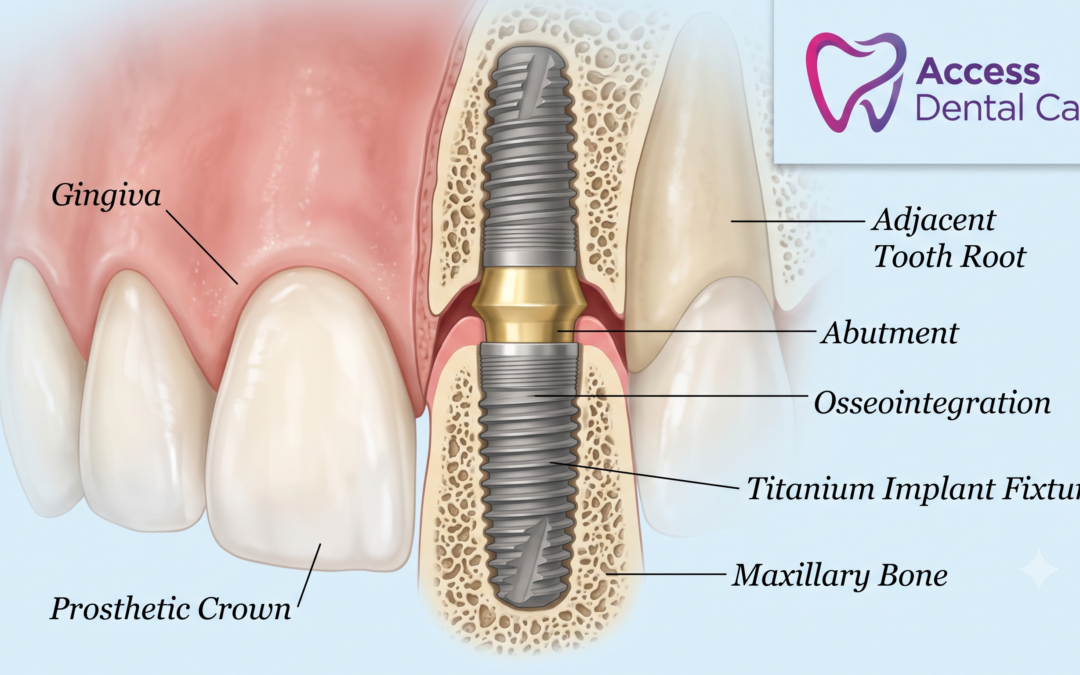
A dental implant is placed in the jawbone to act as a foundation for a replacement tooth. After the implant has healed sufficiently, an abutment and a custom dental crown can be used to restore the visible portion of the tooth. The exact sequence varies from patient to patient.
Can an Implant Be Placed Immediately After a Front Tooth Is Removed?
Will I Have to Go Without a Front Tooth While It Heals?
How Long Does a Front Tooth Implant Take to Heal?
There is no single healing time that applies to everyone. Integration of the implant with the surrounding bone can take several months, and treatment may take longer when an extraction, bone graft, or additional healing stage is required. The dentist will determine when the implant is ready for the next step rather than relying only on a fixed calendar.
Key Factors That Affect Implant Healing
✔ Gum & Periodontal Health: Healthy surrounding biological seal and soft tissue.
✔ Surgical Staging: Whether preliminary extraction or bone grafting is required.
✔ Lifestyle Habits: Smoking or tobacco use, which affects localized blood circulation.
✔ Systemic Health: Specific medical conditions and medications that influence healing.
✔ Oral Hygiene & Follow-up: Diligent home care and adherence to post-op visits.
✔ Bite Dynamics: Excessive occlusal forces, clenching, or teeth grinding (bruxism).
Why Front-Tooth Implant Planning Is Different
The front of the mouth is a highly visible area, so implant planning considers both function and appearance. Gum contours, tooth proportions, crown shade, the position of neighboring teeth, and the patient’s smile line can all influence the final restorative plan.
At Access Dental Care, we take time to ensure that the emergence profile of the tooth blends seamlessly with your natural gingival architecture.